

 122 Saratoga Avenue, Santa Clara, CA, 95051
 (669) 201-8696
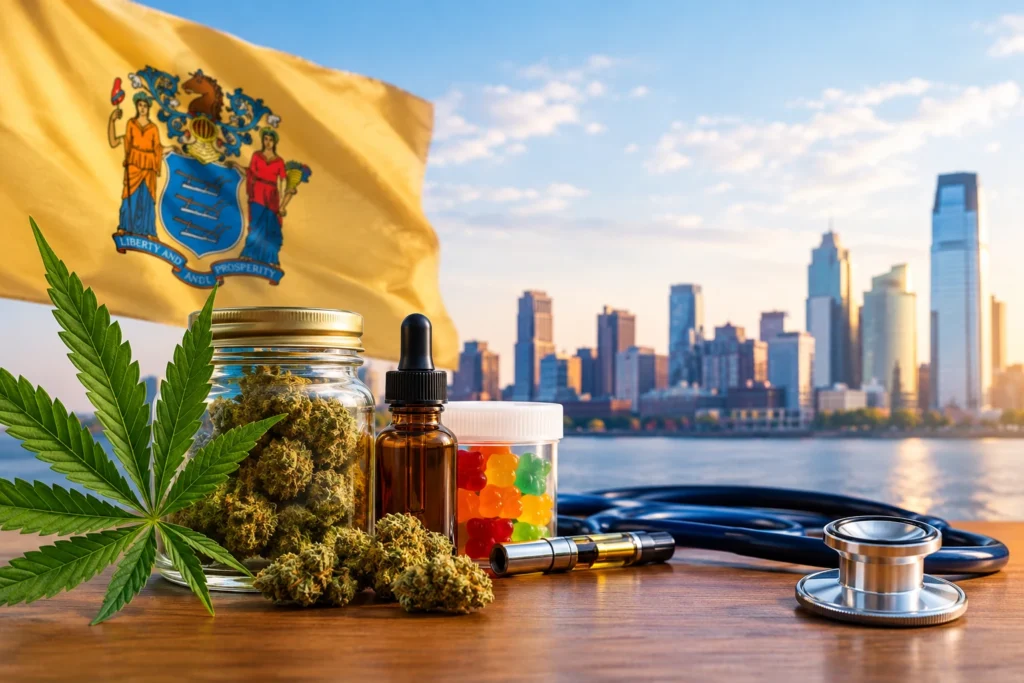
The cannabis business in New Jersey is entering an advanced stage through the development of licensing laws and regulations, enhanced consumer rights protection measures, and increased requirements for specific hemp products. Such events will have an impact on cannabis retailers, medical users, adult users, and companies operating within the regulated market in New Jersey.
Getting to know about the latest changes in the New Jersey cannabis business may be useful for both consumers and businesses to better understand the compliance issues. The recent changes include increased retail licensing options, limitations of intoxicating hemp products, more strict actions against illegal sellers, and further development of regulated cannabis.
Here, we will talk about the 7 most essential New Jersey cannabis changes.
Need guidance on medical cannabis?
Explore your eligibility, learn about the medical marijuana card process, and consult a qualified healthcare professional to understand your options.
>>Get Started<<
In 2021, New Jersey legalized cannabis use for adults 21 years old and over, thus establishing a legal market for the drug. The development of the regulatory framework, the licensing program, and the retail network has been ongoing ever since.
The industry has become a vital economic resource for the state. As per an update by the New Jersey Cannabis Regulatory Commission (NJ-CRC) released in May 2026, the regulated sales of cannabis amounted to more than $1.16 billion in 2025, along with about $67.5 million of the sales taxes earned.
It is critical to understand the above information in connection with the recent New Jersey cannabis reforms.
An interesting trend regarding the New Jersey cannabis changes is that now there are more opportunities for licensees to expand their business operations.
As of April 20, 2026, licensed cannabis retailers in Class 5 can have up to three locations: one dispensary and two satellites. The change provides an increase from the initial limitation of a single store.
This may offer several advantages for licensees:
However, operating multiple stores does not mean that retailers may open stores anywhere they wish. There are licensing requirements of the state and municipalities.
There is another important aspect relating to hemp-derived products containing THC and other intoxicating cannabinoids.
Such products can be sold via the distribution channels that are different from those used by licensed cannabis retailers. New Jersey created a new restrictive regime to distinguish between the products that should be classified as hemp and cannabis-regulated products.
Under the new framework, there is a significance of effective date and product category. As explained by NJ-CRC’s interim guidance, as of April 13, 2026, the products that contain THC in excess of the applicable 0.3% total-THC concentration limit or contain more than 0.4 milligrams of total THC per container no longer will be considered as hemp. Products that contain chemically-synthesized cannabinoids are also restricted.
Moreover, the new rules prohibit online sales of regulated hemp-derived cannabinoid products and intoxicating hemp beverages, vending-machine sales of intoxicating hemp beverages, as well as sell or distribute products with detectable THC to people who are under 21 years old.
How about THC beverages made from hemp?
There are certain regulations that apply to intoxicating beverages made from hemp. According to the regulation in New Jersey, there are limitations on up to 5 milligrams of total THC in a single serving and 10 milligrams in each can, which apply to beverages meeting the requirements set out in the legislation.
Starting from October 2026, one should focus on transition period from November 13 to November 14, when the ban on sales of intoxicating beverages from hemp will start from November 13, while the new categorization of beverages exceeding the THC content in hemp will come into force from November 14.
Market growth necessitates better regulation because unlicensed companies can sell their goods without meeting the regulations set by licensed sellers when it comes to testing, packaging, labeling, verification of age, and security.
The state of New Jersey has taken steps to make the enforcement process more specific by focusing on unlicensed manufacturing, distribution, and selling of cannabis products. This process will involve coordination among New Jersey State Police, local police departments, and NJ-CRC.
This is an important issue when it comes to New Jersey’s cannabis market transformation because the existence of a product on the market does not mean that all necessary requirements have been met.
Licensed dispensaries are supposed to follow the regulations meant to ensure consumer safety and traceability through the supply chain. Unlicensed products may lack any information regarding their potency and ingredients.
How can you identify a licensed dispensary?
Before buying cannabis, there are some simple measures that the consumer should take:
These measures will allow consumers to distinguish legitimate retail establishments from illegal ones.
Another aspect about the New Jersey regulated cannabis market that is emerging is the development of the same outside of the typical retail setting. Some licensed retailers and medical dispensaries in New Jersey could apply for endorsements to have consumption spaces on their premises according to the applicable regulations.
Consumption spaces would be places where people could legally consume Jersey cannabis rather than being able to consume their product in any place they purchase from.
Creating a space for consumption is not just a matter of having some seats in the dispensary itself. There are many other considerations, such as whether the municipality approves it, floor plans, operation details, ventilation details, age verification and even procedures for handling Jersey cannabis products.
Local municipalities will play a significant role in determining whether there could be these kinds of establishments operating within their jurisdiction.
In the industry as a whole, there might be opportunities arising for hospitality-based enterprises.
While adult-use marijuana may be in the spotlight, medical marijuana is still available to registered users of the Medicinal Cannabis Program of New Jersey.
Patients who qualify receive medical marijuana products from ATCs (Alternative Treatment Centers), which require registration, healthcare providers, and rules on patient eligibility.
Legalization of cannabis in New Jersey has also included attempts to regulate and improve access to medicinal marijuana products. Some of the earlier legislation proposed by the NJ-CRC included various ingested marijuana products and clinical research partnerships between dispensaries and medical institutions.
Patients need to take into consideration the following:
Not everyone qualifies to use medical cannabis, and not all products and conditions have strong evidence of effectiveness. Patients need to receive personalized medical guidance and cannot rely on the changes happening in the market as the evidence of effectiveness of a certain product for their condition.
As the market is growing, safety in purchases and responsible consumption have become crucial. Besides the expansion of business possibilities, the latest cannabis rules in New Jersey also demonstrate the attempts of the state to make the regulation better and safer from possible problems with unregulated products.
The licensed products are supposed to meet all the testing, packaging, labeling, and warning requirements. This helps consumers to understand the product, but regulated products do not exclude all risks related to health.
It is possible for the consumer to lower unnecessary risks by following several tips:
Read the label
Look through the THC content, recommended amount, ingredients, and warnings before the product is used. Edibles may work slower compared to inhalation of cannabis, which means that one can consume more product than needed.
Store products safely
Store your Jersey cannabis products in child-proof containers and away from children and pets. Cannabis-infused edibles may be confused with regular foods, and their consumption might require medical intervention.
Do not drive while impaired
The use of Jersey cannabis may influence your attention, reaction time, motor skills, and decision-making abilities. It is important that you do not drive after using cannabis products. It is recommended to plan your transportation beforehand.
Be aware of the potential risks
Cannabis use might result in unwanted effects and may even exacerbate particular risks among certain people. Individuals who are pregnant or nursing, experienced episodes of psychosis before, or are worried about cardiovascular issues need to consult a specialist.
Based on the trajectory that New Jersey is taking regarding its Jersey cannabis legislation, it appears that the sector is getting more organized and regulated. Expanding retail licensees will facilitate expansion within the industry, while the new limitations on hemp and enforcement actions will serve to establish some boundaries.
In terms of consumer considerations, it will become increasingly important to know the purchasing and age restrictions in place as well as licensed vendors as hemp-based products will now be under different regulations.
From the business side, it becomes increasingly important to keep an eye out for statutory changes and obtain any necessary approvals for operations.
The effect of New Jersey cannabis changes will depend on regulatory framework and municipal reaction to it.
The New Jersey marijuana business keeps evolving through modifications to retail licensing, regulations of products derived from hemp, enforcement of the rules, and consumption. This presents an opportunity for licensed businesses and places greater focus on consumer protection.
Being aware of what is changing in New Jersey when it comes to Jersey cannabis will allow consumers to make better choices and businesses to be aware of their responsibilities in a regulated market. Since regulations are subject to change, one should always check with the New Jersey Cannabis Regulatory Commission and laws passed in the state.
1. New Jersey cannabis laws and regulations
Read the New Jersey cannabis laws page
2. NJ-CRC recreational cannabis business licensing
Read business licensing information
3. New Jersey intoxicating hemp-derived product FAQ
Read the official hemp FAQ
4. New Jersey Division of Taxation — Hemp beverage rules
Read the tax and compliance guidance
5. New Jersey Public Law 2026, Chapter 7
Read the full legislation
